SYSTEMS / CONFIGURATION / DEPLOYMENT
Your Code Rolls Out Gradually. Does Your Configuration?
A service’s code release may pass through tests, a limited deployment and health checks before reaching the rest of the fleet.
A configuration change to that same service may take one API call and affect the whole environment within seconds.
The code pipeline can look well protected while other paths receive less attention. I would want to know: what else can change production behavior, and which safeguards cover those changes?
A Cloudflare incident makes that question concrete.
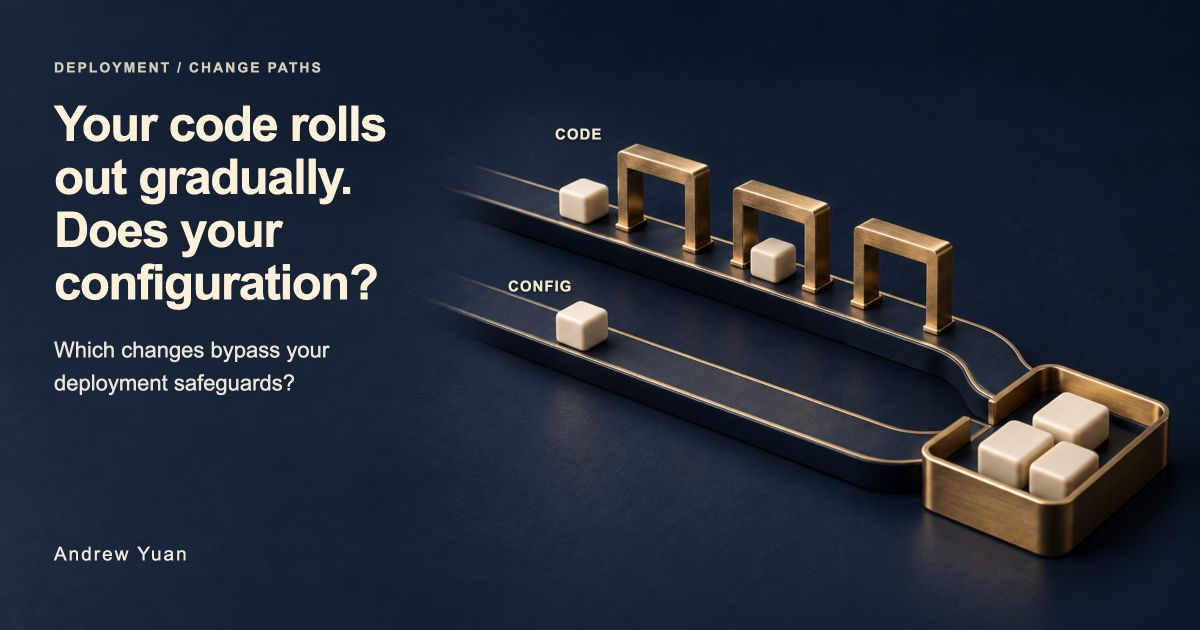
One service, two change paths
On December 5, 2025, Cloudflare was gradually increasing its WAF request-body buffer size. An internal testing tool did not support the new size, so the team made a second change to disable it.
That change used a global configuration system that propagated within seconds. It triggered a Lua bug in the older FL1 proxy, producing HTTP 500 errors for affected requests. The report says the established procedure was followed, but this kill switch had not previously been applied to an execute-action rule. Source: Cloudflare’s incident report
That matters when interpreting the incident. A procedure can have worked before without covering the conditions of the next operation.
The operation’s name is also a poor substitute for tracing its effect. Disabling a testing tool changed a path used to process production requests.
I would assess the change by following what it does: what behavior changes, who is exposed first, and what limits that exposure?
Find the paths that can change the service
Consider a hypothetical public HTTP API service. The example illustrates a change review; it is not a report of an actual deployment.
Its code pipeline is carefully staged. The team can also change rate limits through a configuration API. On-call engineers have a CLI that updates those settings, plus an emergency switch.
Those interfaces are not inherently gaps. The CLI might call the same controlled backend as the deployment platform. The API might already provide versioning, limited exposure and rollback. We need to trace the implementation before deciding.
I would follow one rate-limit change from the request to the application using it. Who can initiate it? Which backend handles it? Which requests are affected first? What permits the change to expand?
Amazon’s Builders’ Library describes separate pipelines for different sources, including configuration and feature flags, using similar deployment safety techniques. The paths can differ while still needing appropriate protection. Source: Amazon Builders’ Library
That inventory gives a statement such as “our deployments are protected” an explicit scope. It also reveals where investment is still needed.
What permits the next stage?
Suppose the service can apply a setting to a small group of instances first. We still need to ask what that group can tell us.
If it receives no relevant traffic, there is little opportunity to observe the change. If every instance in the group runs a newer runtime, older versions elsewhere remain untested.
A fleet-wide average can also dilute severe errors in a small cohort. Google’s SRE discussion of canarying emphasizes the population, traffic, duration and whether the metrics can be attributed to the change. Source: Google SRE
For the rate-limit change, I would compare request success, unexpected rejections and latency in the exposed and control populations. I would also check that the observation window included requests the new limit could affect. Successful configuration parsing is one check in that assessment.
The team needs a decision for insufficient evidence. A routine change might pause. During an incident, waiting has a cost that must be assessed separately. The important part is to make that decision explicit rather than silently treating missing data as a pass.
I would also examine whether exposure is actually contained. A change on a few instances could still affect a shared resource. A small instance count does not, by itself, establish a small impact radius.
A staged rollout creates opportunities to gather evidence. Whether that evidence is enough depends on traffic, dependencies and observable outcomes.
A shared capability still needs adoption
Cloudflare’s May 2026 Code Orange: Fail Small follow-up describes Snapstone, which brings progressive rollout, health monitoring and automatic rollback to configuration deployments. Previously, those protections required substantial work by individual teams and were applied inconsistently. Source: Cloudflare’s follow-up
If every team has to build deployment state, connect monitors and implement recovery, that work competes with product delivery. Shared infrastructure can reduce duplication. Migration, adoption and maintenance still need time.
I would divide the responsibility as follows. The platform team maintains common versioning and deployment controls. Service teams define meaningful health signals and connect the relevant change paths. Engineering managers provide time and priorities for the work, with accountable decision-makers participating in acceptance of remaining exposure.
Acceptance should cross those team boundaries. Can a controlled change stop or recover under the failures it is meant to handle? Do the operation, alarm and service outcome leave records we can reconcile?
Otherwise, the platform team can regard the tool as delivered while the service team has no migration time. The unprotected path remains.
Adoption also needs maintenance. A new operator interface, a monitoring change or a service redesign can alter the coverage we previously accepted.
Prepare for urgent changes before they are urgent
A switch that removes a bad rule too slowly can prolong an incident. A fast change can trigger another defect and spread the impact.
Before an incident, I would distinguish emergency operations with a defined, tested purpose from changes that require a new judgment under pressure. They may warrant different speeds and decision procedures.
For the hypothetical service’s emergency switch, I would establish the permitted scope, who can authorize acceleration, which observations remain available, and who stops or reverses the operation if it does not help.
There is a separate readiness question: will responders still have the access and visibility they need while the system is failing? That is different from rollout speed, but it affects whether recovery is practical.
Cloudflare’s follow-up describes internal tools depending on its own infrastructure, creating a risk of losing repair access during an outage. It reports adding backup authorization paths and exercising them. Source: Cloudflare’s incident-response improvements
That capability needs engineering work and practice beforehand. Exceptions that remain available also need maintenance. A temporary repair path left in place becomes another production change path to account for.
Published, available and applied are different observations
The publishing system and the application may not finish together. AWS AppConfig Agent, for example, uses a local cache and asynchronously polls for updates. Understanding when a setting takes effect also requires understanding how the application obtains and uses it. Source: AWS AppConfig Agent
For the hypothetical service, I would record the deployment request, configuration version, version actually in use and relevant request outcomes. Acceptance of the deployment request is only the first observation; the applied version and request outcomes show what reached the service.
Recovery needs the same distinction. After the control system returns to an older setting, check the application’s state. External effects already caused may require separate action. This connects to the question of whether a rollback target can handle the data now present.
Automatic rollback has dependencies too. AWS AppConfig’s documentation explicitly notes that disabling actions on an associated CloudWatch alarm prevents automatic rollback in response to it. Source: automatic rollback monitoring
I would therefore verify that the safeguards are active on the path being used, then check service outcomes after rollback. A platform offering a rollback feature is only part of that acceptance.
Turn the gaps into decisions
Suppose the API service’s review produces the following findings. These are illustrative, showing how observations can lead to work and operating decisions.
On narrow screens, scroll the table horizontally to read every column.
| Change path | Hypothetical finding | Next decision |
|---|---|---|
| Code pipeline | Staged deployment; health results distinguish versions | Service team maintains the signals and stop conditions |
| Configuration API | Version history exists; changes affect every instance at once | Prioritize limited exposure; restrict which changes may use the global path in the meantime |
| Operator CLI | Confirmed to use the same configuration backend | Include the CLI path when accepting the configuration safeguards |
| Emergency switch | Fast propagation; only a limited set of uses has been tested | Record tested conditions, decision authority and recovery steps; schedule an exercise |
The review can now address concrete trade-offs. Does the configuration API’s reach justify earlier investment? What should be restricted until the improvement is ready? Which emergency operation needs an exercise? Who will complete the work, and does the team have time?
An adoption percentage alone is a weak completion measure. One uncovered path with fleet-wide reach may deserve attention before many lower-risk interfaces.
When someone says “it is only a configuration change,” I would want the team to be able to continue: who will it affect first, what will we observe, what permits expansion, and who can stop it?
Specific answers support decisions about release speed, accepted exposure and the work needed to keep those answers valid.
Sources and scope
This article analyzes public incident reports and technical documentation. I have not tested the Cloudflare or AWS deployments described. The service example, responsibility split and acceptance approach are my proposals. Vendor-reported improvements are not independent verification or a general reliability guarantee.